Overview & Origin
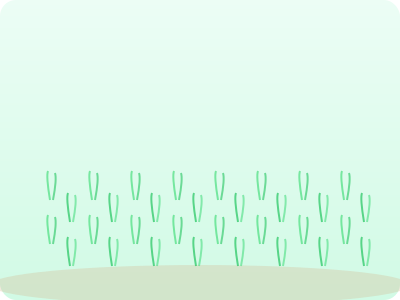
Dwarf Hairgrass (Eleocharis parvula, sometimes labeled Eleocharis acicularis 'mini') belongs to the sedge family Cyperaceae. It's found in temperate and tropical regions worldwide, growing in shallow waters, marshes, and along river edges. In its natural habitat, it forms dense mats in areas with good sunlight and flowing water.
In aquascaping, Dwarf Hairgrass is the classic choice for creating a grassland effect. The Iwagumi aquascaping style — characterized by rocks emerging from a carpet of green — frequently features Dwarf Hairgrass as the primary plant. It also works beautifully in nature-style and mixed-plant aquascapes as a foreground carpet.
How to Plant Dwarf Hairgrass
- Preparation: Remove tissue culture gel by gently rinsing under water. Separate the portion into small clumps of 5–10 blades each.
- Substrate: Fine-grained substrates are essential — ADA Amazonia, Fluval Stratum, or even fine sand. Coarse gravel prevents runner spread and makes planting difficult.
- Technique: Using planting tweezers, push each clump about 1 inch deep into the substrate at regular intervals, spacing clumps 1–1.5 inches apart in a grid pattern. Closer spacing means faster carpet coverage.
- Patience: The initial few weeks look sparse. Resist the urge to rearrange — the plant is sending runners beneath the substrate and will fill in over time.
Lighting Requirements
Dwarf Hairgrass needs medium to high light for successful carpeting — 50–70 PAR at substrate level is ideal. Under insufficient light, it grows tall and thin instead of spreading laterally, and will eventually die back.
A quality LED fixture with good substrate-level coverage is important. Hot spots and dark areas will result in uneven carpet growth.
Water Parameters
- Temperature: 68–82°F (20–28°C)
- pH: 6.0–7.5
- KH: 2–8 dKH
- GH: 3–10 dGH
CO2 & Fertilization
CO2 injection is strongly recommended for Dwarf Hairgrass. While it can survive without CO2, achieving a dense carpet is extremely difficult in low-tech setups.
- With CO2: Dense carpet in 6–10 weeks. Inject to reach 25–35 ppm. Growth is faster and blades stay shorter and more compact.
- Without CO2: Possible but slow — expect 3–4 months minimum for partial coverage, and the carpet may never be as dense. Very high light and nutrient-rich substrate are essential.
- Fertilization: Root tabs every 4–6 weeks (Dwarf Hairgrass is a moderate root feeder) plus liquid fertilizer 2–3 times per week. Iron and micronutrient supplementation keeps blades vibrant green.
Maintenance & Trimming
A healthy Dwarf Hairgrass carpet requires regular trimming:
- Trim to about 1–1.5 inches when the carpet reaches 2–3 inches. Use sharp, flat aquascaping scissors for an even cut.
- Trimming actually stimulates the plant to send out more runners, thickening the carpet. Regular mowing promotes lateral spread.
- After trimming, net out floating cuttings immediately to prevent them from rooting elsewhere.
- Siphon debris from the carpet surface during water changes — detritus accumulation in the blades promotes algae.
Common Problems & Solutions
- Growing tall, not spreading: Insufficient light and/or no CO2. Increase light intensity and add CO2 injection.
- Browning blades: Can indicate nutrient deficiency, insufficient light, or emersed-to-submersed transition. New submersed growth will be green — trim the brown blades to encourage fresh growth.
- Algae in the carpet: Hair algae and green algae can infest the fine blades. Ensure proper CO2 levels, don't exceed 8 hours of light, and add amano shrimp as cleanup crew.
- Patchy growth: Uneven lighting across the substrate. Reposition the light fixture for better coverage, or add supplemental lighting for shadowed areas.
- Carpet dying at base: If the carpet is too thick, lower layers get no light and die. Trim regularly to prevent this.
Frequently Asked Questions
Dwarf Hairgrass vs Monte Carlo — which is easier?
Monte Carlo is easier. It carpets more reliably without CO2, stays lower, and is more forgiving of light inconsistencies. Dwarf Hairgrass creates a more grass-like, natural look but requires higher light and ideally CO2.
Does Dwarf Hairgrass need CO2?
Technically no, but practically yes for a nice carpet. Without CO2, growth is extremely slow and the carpet will be sparse. CO2 injection transforms results dramatically.
How long does Dwarf Hairgrass take to carpet?
With CO2 and high light: 6–10 weeks. Without CO2: 3–6 months, if it carpets at all.